


Everything you want to know about identical and fraternal twins
Of course it is something very especially with twins? The most common type of twins are fraternal twins, less common are identical twins. In addition, there are three varieties of identical twins! Maybe you are wondering what the difference is? In this article, we'll go through everything you need to know!
The feeling that comes with discovering that there is not one but two(!) babies in your belly is one that not many can imagine or relate to. Thoughts such as how to cope with carrying two little lives in your belly and then going through two births naturally come up, and so we want to go through some practical information for those expecting twins.
The number of twin births in Sweden per year is between 1000-2000 and this corresponds to 1-2% of all births. Twin pregnancies have been increasing for a number of decades due to a higher age of pregnant women and more IVF treatments/pregnancies. In recent years, however, the increase has slowed down, as IVF treatment usually involves the return of only one fertilized egg.
Fraternal twins
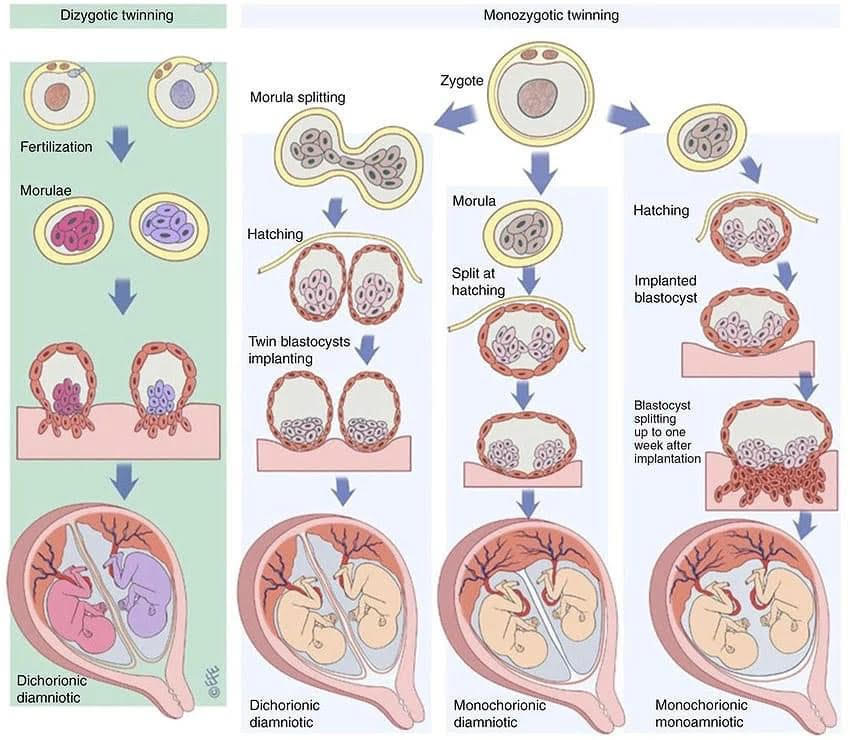
Fraternal twins are also called dizygotic, and make up about 70% of all twin pairs. They occur when two eggs are fertilized by two different sperm. Identical twins are to some extent hereditary and they are no more genetically similar to each other than normal siblings. In the womb, they grow in their own sac and each has a placenta, called a DCDA.
Identical twins
Identical twins are also called monocygota, and make up approximately 30% of all twin pairs. They have an identical genome and are always the same sex.
It is a bit of a coincidence that identical twins are born, because it happens when one fertilized egg divides. The type of identical twins that result depends on the timing of the division.
Here we go through the different types of monocygota!
- If the egg splits at an early stage (around day 0-3), the twins, like fraternal twins, will each have a placenta and a perineal sac in the womb. This is called DCDA.
- If the division occurs on day 4-8 after fertilization, the twins will share a placenta but will each have a sac with a thin septum called the MCDA.
- If the division occurs on days 8-13, the most unusual form of twins occurs. In this case, they lie together in the same sac and they also share the placenta. This is called MCMA. If division occurs after day 13, Siamese twins may form, meaning they are conjoined.
High risk pregnancy
A pregnancy is considered full-term from week 37+0. Half of all twins are born prematurely, before week 37+0. Of these, about 10% are born before 32+0 weeks. There are various reasons why they may be born prematurely, such as congestion in the womb or complications that require the babies to be delivered earlier.
As the burden on the pregnant woman is twice as great as in a 'normal' pregnancy, a twin pregnancy is considered a high-risk pregnancy. This means that there is an increased risk of complications for both the pregnant woman and the babies in the womb. However, this does not mean that the pregnancy has to be risky - it can be perfectly fine.
Want to read more about twin pregnancies? Click here to read more!


